Welcome to the Prehoda lab
We are a research group in the Institute of Molecular Biology and Department of Chemistry and Biochemistry at the University of Oregon
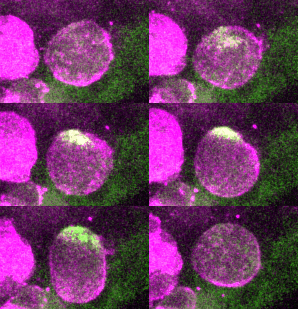
We study how neurons, one of the most complex cell types, are made during development. We combine the latest microscopy methods with the awesome power of reconstitution biochemistry to understand neurogenesis.
Find out more below!
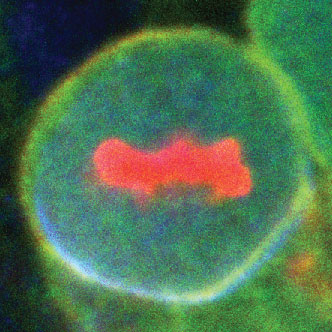
We study how animals make neurons during development using Drosophila neural stem cells as a model system. Neural stem cells undergo repeated asymmetric divisions to populate the fly central nervous system. After a cycle of division, one daughter cell retains the stem cell fate while the other goes on to become neurons or glia. The foundation of this amazing process is the segregation of the activity of fate determinant proteins into the two daughter cells during mitosis. Our work attempts to uncover the molecular basis of asymmetric fate specification through the study of cell polarity and fate determining factors.
The first step in fate determinant segregation is their polarization, in which the proteins localize to opposite regions of the cell membrane. How does the cell become organized in this way? We have studied the Par complex, a set of three proteins that polarizes many different cell types, including stem cells. A kinase, atypical Protein Kinase C, is a key component of the Par complex, as attachment of a phosphate to downstream proteins polarizes them. We are trying to understand how cells control where the Par complex is localized, and how substrate phosphorylation leads to their polarization. Loss of polarity is a hallmark of cancer, and we are also studying the relationship between polarity and tumorigenesis.